February 06, 2010 • General
Hello once again to everyone out there in the blogosphere. Before I dive right into talking about Wijk, I would like to clear up a certain rumour from the online world. I am not playing in Aeroflot, nor did I ever seriously consider it. Any suggestions to the contrary are simply not true. Now that this is out of the way, onto the tournament recap!
Round 1: Smeets-Nakamura
In the first round, I had Black against Dutch GM Jan Smeets. Like quite a few other European GMs, I have seen him at several tournaments over the past few years but not had the opportunity to play. Overall, Jan seems to be a very solid player with a pretty good general knowledge of openings. In our game, he surprised me by playing the 6.Bg5 variation against the Najdorf. As fate would have it, the tournament seemed to be a referendum on whether the Bg5 variation is good for White or not. I picked a mild sideline which surprised Jan, and he played a tame variation.
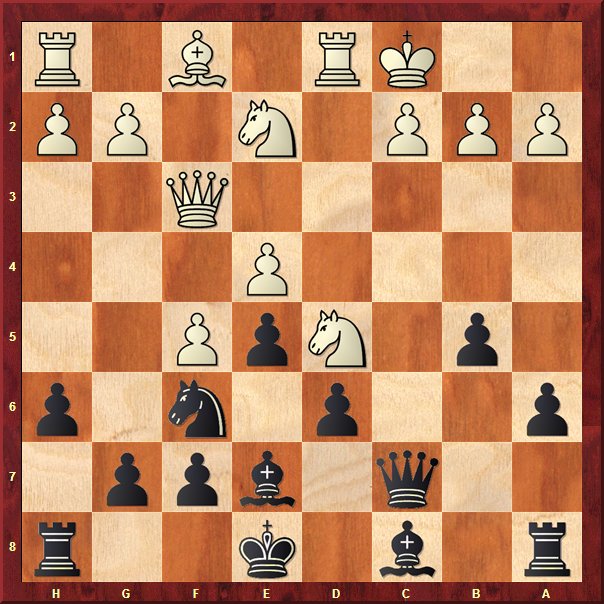
The following was the position after 14.Nd5. Oddly enough, our silicon friends seem to think 14…Nxd5 was simply better for me, but I thought White had a solid positional advantage after 15.exd5 followed by eventually putting a knight on e4. When I chose to avoid this variation, the position eventually fizzled out and it was a fairly standard draw. Overall, I felt that coming off of the tournament in Turkey this was a great start to the tournament with a solid draw as Black. Onto round 2!
Round 2: Nakamura-van Wely
In the second round I had White against another Dutch man albeit it, one who is a bit older and stronger! Shockingly Loek was playing in Wijk for a 19th! straight year. The last time we played in Amsterdam, I was White in a Najdorf, but blundered in a completely winning position and he was able to escape with a draw. This time around, we played another Najdorf although I decided to play the 6.Bg5 variation against him. Unfortunately for Loek, I was very well prepared and he walked right into my preparation.
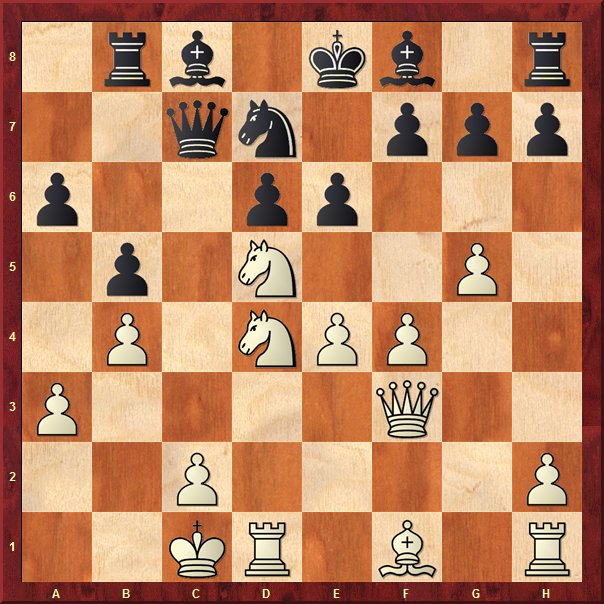
This is the position after 15.Nd5. Unlike the game against Smeets, the knight on d5 is actually an intentional piece sacrifice. Prior to the game, I had prepared this variation with Kris and we concluded that the position might be holdable for Black, but it would be extremely unpleasant for a human to play. As it turned out, our assessment was correct since Loek went wrong almost immediately and simply got blown off the board. It was after this second round game that I realized I would at least have a chance of putting together a good showing in the tournament.
Round 3: Short-Nakamura
In the third round, I faced another familiar opponent in Nigel Short. Having faced Nigel only the month before in the London Chess Classic, I had become fairly familiar with his style. During the tournament in London, Kris and I both lamented having White against Nigel and not Black as we felt Nigel was significantly more solid with Black than White. This time around, I decided to surprise everyone by playing the Classical Sicilian. Having played it in Turkey during the World Team Championship, I felt like giving it a whirl! Nigel deviated from prep very early on by choosing to play the Boleslavskij variation. At which point the following critical position arose.
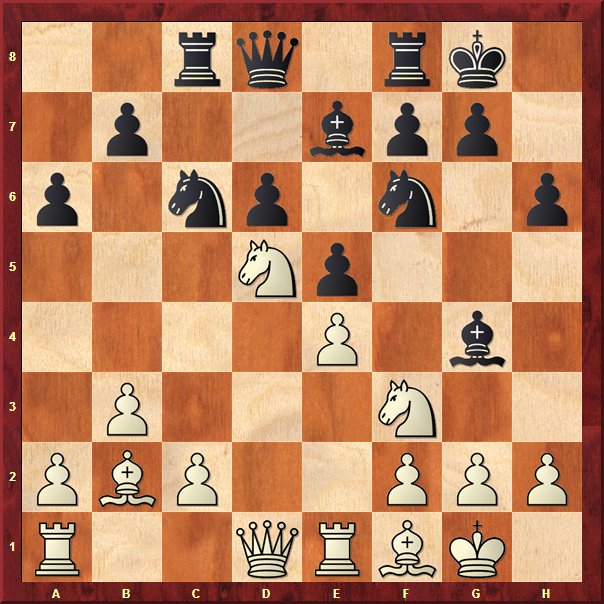
This critical position occurred after 13…Bg4. Strangely enough, this was the third straight game of mine featuring a knight on d5, and it certainly wasn’t the last either! Here, Nigel went badly astray with 14.c4. This move isn’t necessarily awful, but after 14…Nxd5 15.exd5 Nb8, I had absolutely no problems as well as having an easier position to play. After the game, Nigel seemed to think 14.Nxe7 Qxe7 15.c4 gave White an advantage, but subsequent analysis shows that there is no advantage at all after 15…Nd7 due to Nc5-e6-d4 ideas later on. Although Nigel probably could have maintained the equilibrium and drawn, a few minor errors in a row doomed his position and I pounced on them to win my second game in a row. More than the great start, I was pleased by my calculation and accuracy in playing the best moves. From the first three games, I very rarely deviated from the Rybka suggestions in any given position.
Round 4: Anand-Nakamura
In the fourth round, I faced my first major test as I had Black against the current World Champion, Viswanathan Anand. Many people have asked me if I felt nervous before the game. Having played against Carlsen and Kramnik in London certainly helped me as this felt like just another game. I think that once you play against anyone who is top five, you inevitably realize that it is just a name and they are still “only human.” As such, I did not feel nervous at all and enjoyed the moment instead! Regardless of what happens, I can certainly tell my children in the future that I played a World Champion! That in itself, is more than enough!
The game itself started off as a Leningrad Dutch. Recently, I have started playing the Dutch frequently as it is an opening which is unbalanced and gives both sides chances. I also felt that as Vishy is not a native d4 player, something off the beaten path would yield me better chances. The opening was fairly tame, as I avoided several chances to go for serious complications. Eventually we reached the moment of truth.
In this position, the obvious trump for White is the better pawn structure with only one potential weakness in the pawn on a3. During the game, I actually felt mildly nervous as I had overlooked 19.Rac1 Nb5 20.Rxc6! after which White is close to winning. However, during the game I noticed the nice safety moves 19…Nf7 contending for and eventually preparing to play e5. Vishy chose a much less testing continuation in the more natural 19.Ne5 after 19…Bxe5 20.dxe5 I had the nice tactical shot in 20…Qa5! after which the position is almost completely dead equal. This led to a draw shortly there afterwards. Once again, I went in there with a goal and held my own with Black.
Round 5: Nakamura-Carlsen
In the fifth round I was White against another opponent who has become a bit too familiar. Having played Magnus so many times recently, (Norway,London) I have become extremely familiar with his style. This time around, I decided to deviate early and play the exchange Ruy Lopez. I felt this was simply a practical choice as I avoided any deep analysis by Magnus or Garry. In many ways, when I play against people such as Magnus, I try to play simple chess and just outplay them instead of playing a different game called memorization.
In the game itself, my plan worked out nearly perfectly as Magnus lashed out with the dubious 10..b5 which was a novelty. After this error I certainly had some initiative although, much to his credit, Magnus was able to alleviate the pressure and simplify into an ending where he had three pawns for a piece. During the game, I felt I did not miss any clear wins, although the following position is where many people thought I had winning chances.
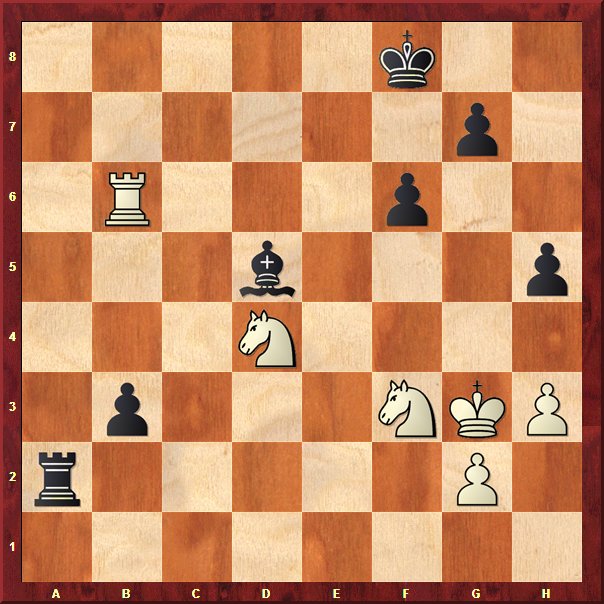
In this position, I chose to play 47.Ne6. Many people seemed to be of the impression that 47.h4 was winning, but upon further analysis 47…b2 48.Nf5! g5! 49.Rxf6 Ke8 50.Rb6 gxh4 51.Kxh4 Kd7 followed by b1 leads to a simplification and a draw. After the game, I was rather disappointed that I could not win but sometimes chess is simply a draw.
Stay tuned for Part II shortly! Have a great Superbowl weekend, everyone!
Cheers,
Hikaru! 2.6.10
February 01, 2010 • General
Greetings to everyone out there once again! Since I am spending much of the next 24 hours traveling, I will not be able add a blog until I am back in the US. Having said that, I hope everyone enjoyed the games, and I look forward to recapping all the exciting action over the past month!
December 11, 2009 • General
Good morning to everyone from gloomy London. I must say that having spent time in Seattle and Vancouver, I have gotten fairly used to overcast days. However, the weather here seems to be a steady forecast of clouds followed by rain and then more rain later on. Luckily, I am here to play chess which does not require nice weather, THANKFULLY! Overall, though, I do like most of the chaps I have met during the tournament thus far. The organization has been first class, and I have had a good time. Now onto what everyone is interested in- the games.
In round 1 I had White against Chinese GM Ni Hua. In a slight surprise, Ni Hua chose to play the a6 slav. This variation seems to be in fashion once again as GM Vladimir Malakhov used it with a lot of success during his deep run into the semifinals of the Fide World Cup (he should be in the final). I chose to play the ultra slow 5.Bd2. The next few moves were pretty standard until we reached the following position.
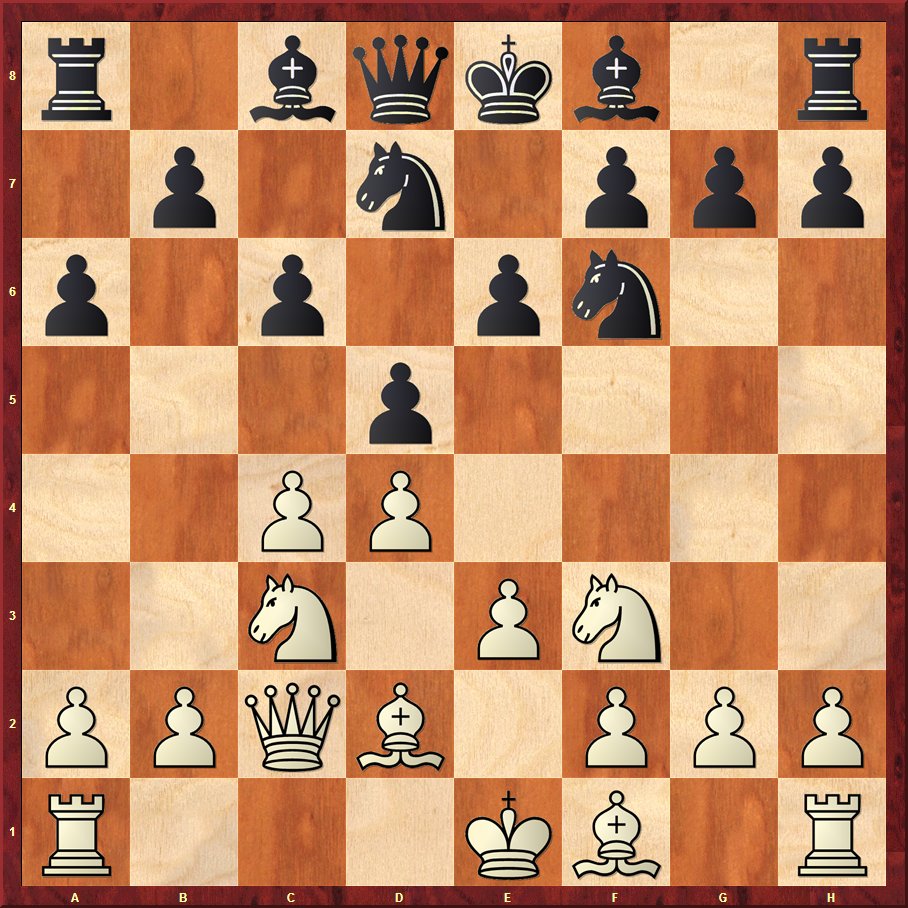
A) In the two previous times that this line was played against Ni Hua, he chose to play 7…c5 which led to razor sharp play after 8.cxd5 exd5 9.g4! which was played twice between Malakhov and Ni Hua in the Russia-China match earlier this year.
B) 7…Be7 is also playable, but White has a small edge after 8.e4 dxe4 9.Nxe4 Nxe4 10.Qxe4 c5 11.Bc3
C) 7…Bd6 8.e4 dxe4 9.Nxe4 Nxe4 10.Qxe4 c5 11.Bc3 with a similar position as in line B.
D) 7…dxc4 leads to a much different sort of middlegame struggle than the other three variations.
In the game, Ni chose to play 7…dxc4 and I had a small advantage until he went badly astray with with 18…Bf6 which allowed the nasty shot 19.Bd2-a5!
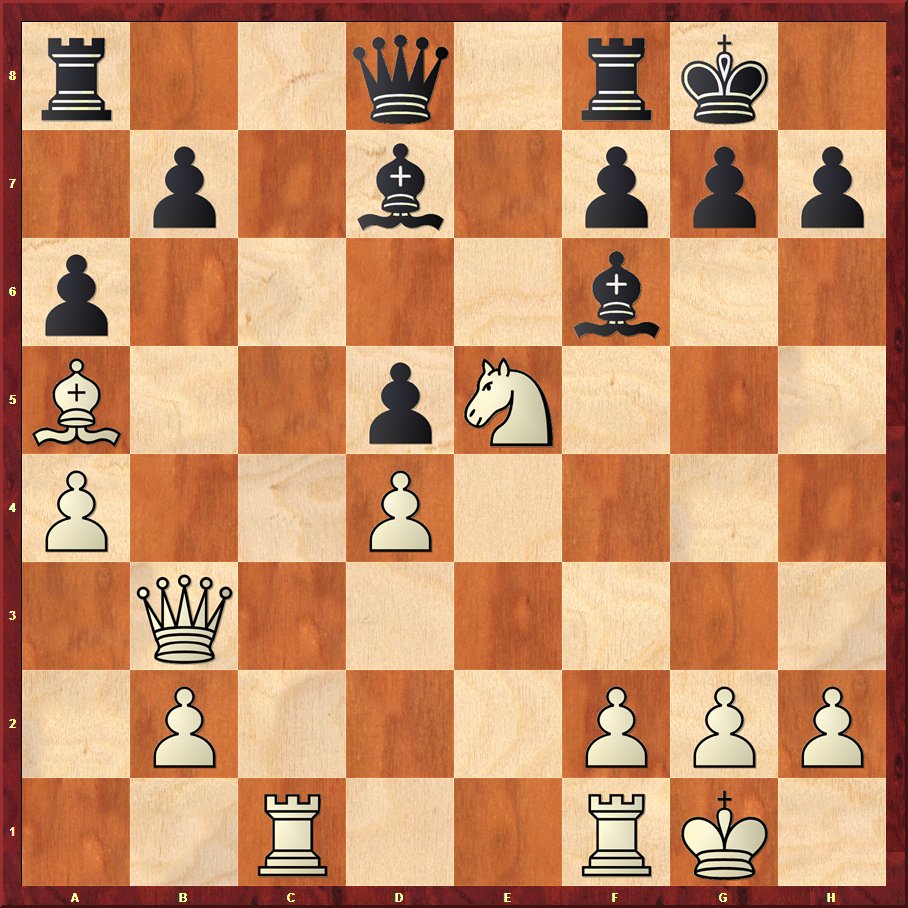
Clearly, Ni had missed this move as he started shaking his head profusely. I hardly blame him, as Black is probably very close to equal if not for this crushing move. After a forced series of moves, I had a significantly better endgame up an exchange. In a slightly dubious decision, I decided to give it back up and play a rook and pawn endgame up a pawn. Had Ni tried 36…Ke6 instead of Ke4, he probably would have had some good drawing chances. However, after 37.Rd7 I was clearly winning. Unfortunately, right before time control I completely hallucinated.
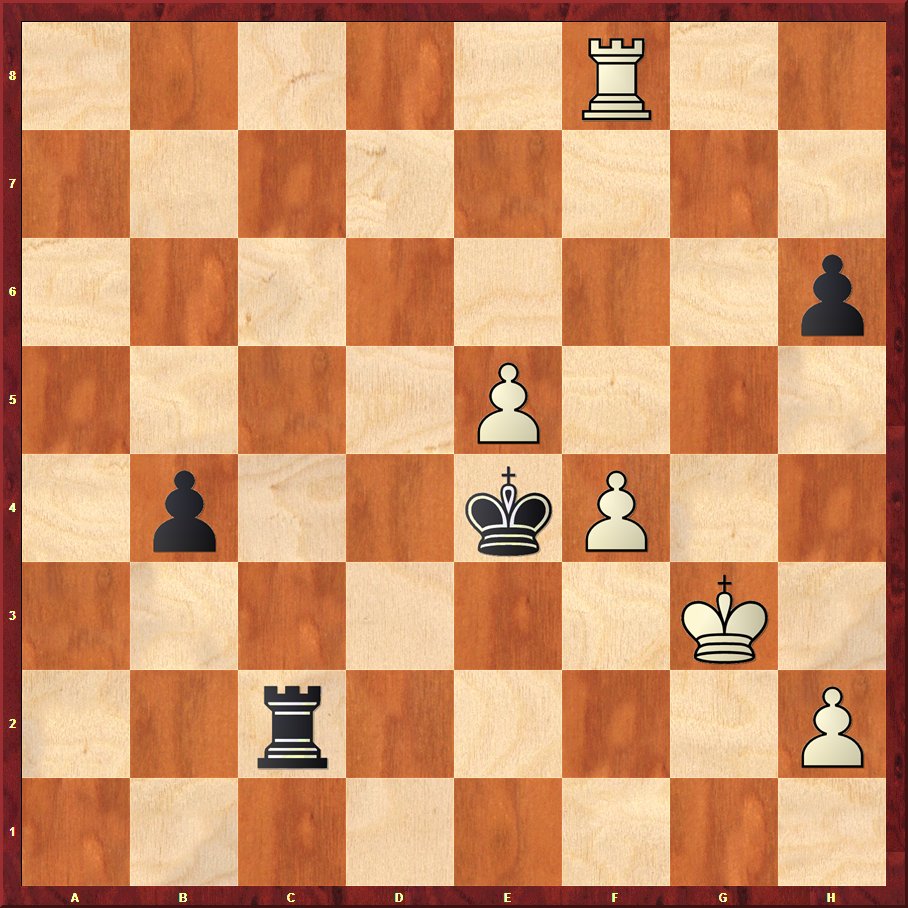
In the following position, I used up 35 of my final 40 minutes on this key position. For some odd reason, I calculated this ending correctly, but with one problem. I thought the pawn was on h5 not h6. One might wonder what difference does that make? I had foreseen 40.e6 Rc7 41.f5 Ke5 (41…b3 42.f6 b2 43.e7 b1=Q 44.e8=Q+ Kf5 45.Qh5 with a winning position.) 42.Rf7 Rc8 43.e7 Re8 (43…b3 loses to 44.Rf8) 44.f6 b3 45.Rf8 b2 46.f7! the whole point of this line. Now, with the pawn on h6 it is winning, but what did I see? I saw 46…Rxc7 47.Re8 b1=Q 48.Rxe7 Kd6 49.f8=Q Qg1+ 50.Kh3. This position is clearly winning as Black has NO CHECKS. However, if the pawn is on h5, neither Kh3/h4 are possible as Qg4 is checkmate. 50.Kf3/f4 also lose to Qf1 as I drop the queen on f8. I am not really sure what to chalk up this hallucination to, but alas it happens.
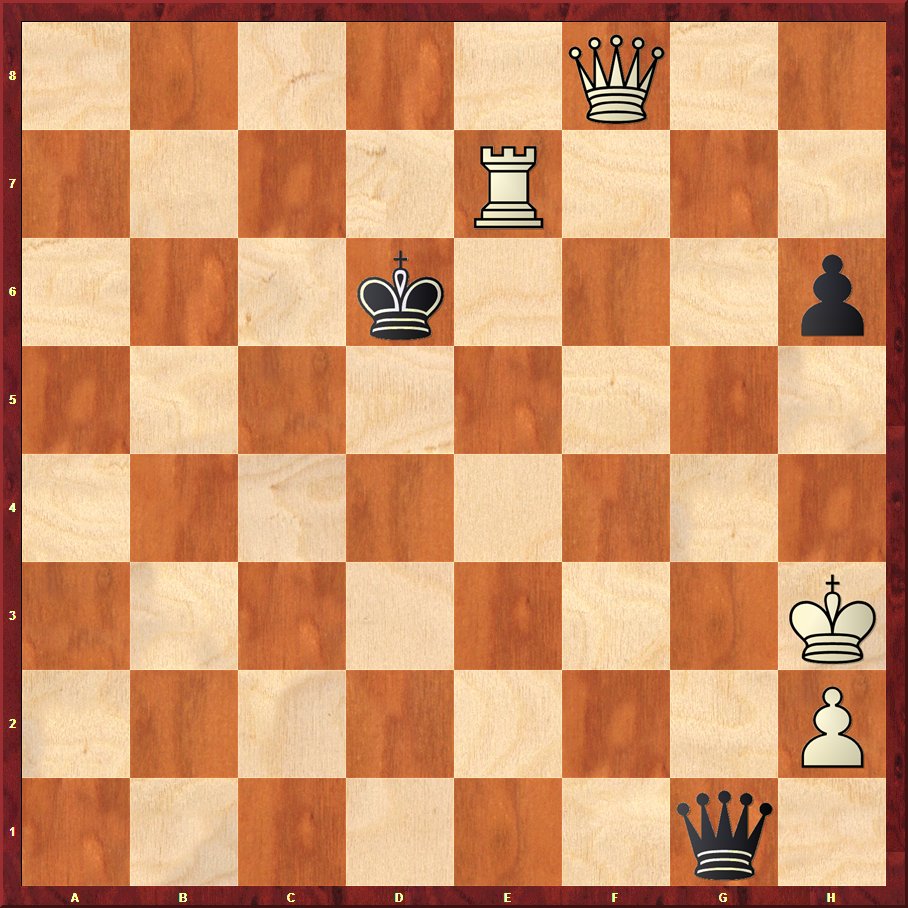
The rest of the game was not really noteable as Ni held without making any errors and it ended in a draw a few moves later. Overall, I felt it was a very good first round performance except for the ending.
In round two, I had black against British GM Michael Adams. I have only faced Adams twice with both games being way back in 2004 when I had a sensational run making it into the fourth round of the Fide World Cup in Tripoli, Libya. As the games were a very long time ago, I was unsure what to expect. Adams had been a top ten player for what seemed like an eternity. Recently, he seems to have had a few bad results which led to him falling below 2700 which seems a bit ridiculous to me.
I decided to trot out the French for the first time in a few years and Adams chose to play the Tarrasch. Shockingly, I believe this is the first time I have actually faced the Tarrasch in classical chess. I prepared the 3…Be7 variation. For some reason, I completely forgot about the game Adams-Caruana from the last olympiad. Instead of playing Nc7 followed by Nb8-c6, I chose the dubious plan of Nc7 followed by Qc8-a6. This was a rather careless choice on my part as it improves White’s queen position and takes my queen completely out of the game. The other huge problem it creates is that there are no concrete plans for Black while White just brings his queen over to the kingside and harrasses me with his knights. In the end, I had to go for the hideous plan of f5 which left me with a permanently backward pawn on e6 for the rest of the game. Fortunately for me, Adams could not find a clear way to put more pressure on the pawn and I was able to create complications.
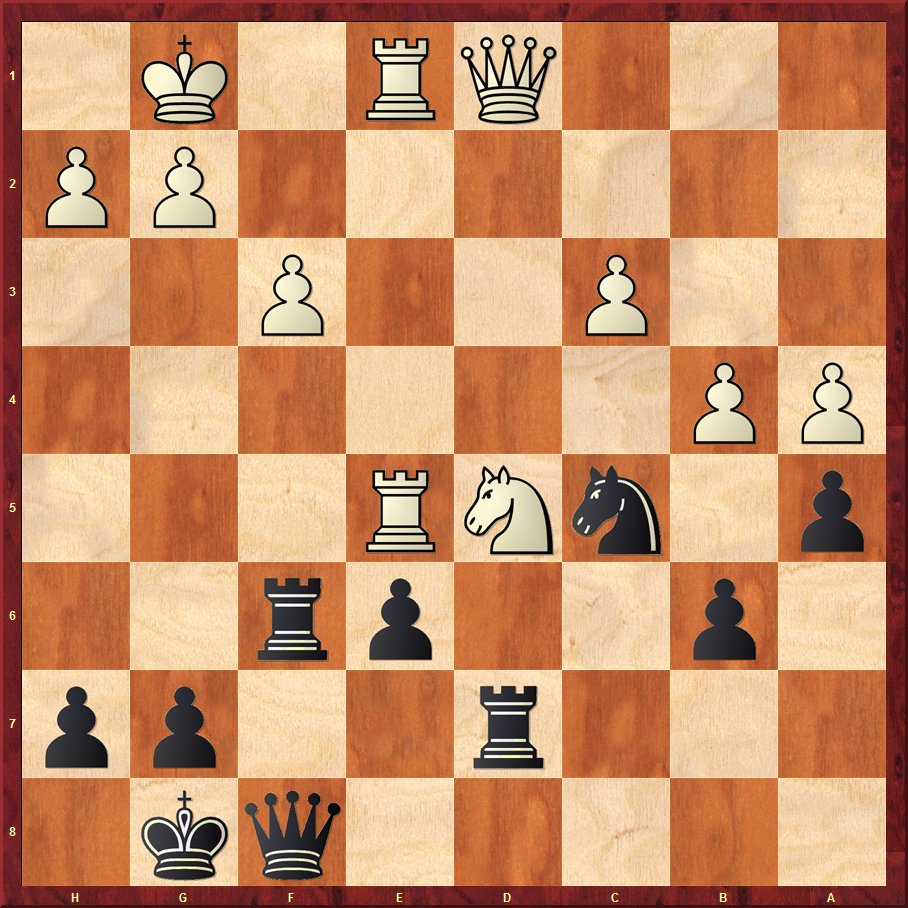
Here, I once again had a similar hallucination as in round 1.
A) 32…Rd8 was the best move in the position. After this, White has only a symbolic advantage after 33.Kh1 exd5 34.bxc5 Qxc5 35.h3.
B) 32…Rf7 33.bxc5 (33.Rxe6 is also possible, but White gets nothing after 33…Rd8! 34.Qb3 Kh8.) 33…Qxc5 34.Kf1 (34.Qd4 Qxd4 35.cxd5 Rxd5 36.Re5 Rc7! 37.Rxd5 Rc4 which is a drawn ending.) 34…Rxd5 35.Rxd5 exd5 36.Re5 h6 37.Qxd5 Qxd5 38.Rxd5 Rc7 with another drawn rook and pawn endgame.
C) 32…cxb4? Once again the incorrect decision. In fact, I thought that by trading on b4, I could reach a favourable version of line B above, but the problem is that after 33.cxb4 Rf7 White has the very strong 34.Qd4! which I completely overlooked. After 34…Rxd5 35.Rxd5 exd5 36.bxc5 Qxc5 37.Qxc5 bxc5 38.Re8 Rf8 39.Rxf8 Kxf8 40.a5! and I cannot prevent the a pawn from queening. Once I saw this disastrous line, I panicked and immediately went 33…Rd8? (33…Rf5 probably would have led to a draw after 34.Rxf5 Qxf5 35.bxc5 Rxd5 36.Qe2 [36.Qb3 bxc5 37.Qb5 Rd8 38.Qb6 Qd5 and White will eventually have to go into an endgame where I can trade the c pawn for the a pawn.] 36…Rxc5 37.Qxe6 Qxe6 38.Rxe6 Ra5 39.Re4 b5 where we reach a theoretically drawn endgame.) completely forgetting that after 34.Nxf6 gxf6 35.Qc2 fxe5 36.bxc5 that I did not have a pawn on g7 in this endgame! After this horrendous gaffe, I had to suffer in a losing rook and pawn endgame. Luckily, Adams butchered it quite severely and I got a miraculous draw.
Yesterday, I got my second White of the tournament against the olive farmer, aka Nigel Short. Short has had a resurgence over the last few years and is playing extremely well considering that he is 44 (ancient in chess years). The only other player who seems to have maintained such excellent form this late into their career is GM Boris Gelfand from Israel. Unfortunately, unlike most of the other players in this tournament, Nigel is rock solid and rarely takes risks when he is Black. Unlike the first two games, this one was much more balanced and I gained a space advantage out of the opening which was a Rubinstein Nimzo-Indian. Overall, I played pretty accurately although I did have one chance which both Nigel and I overlooked.
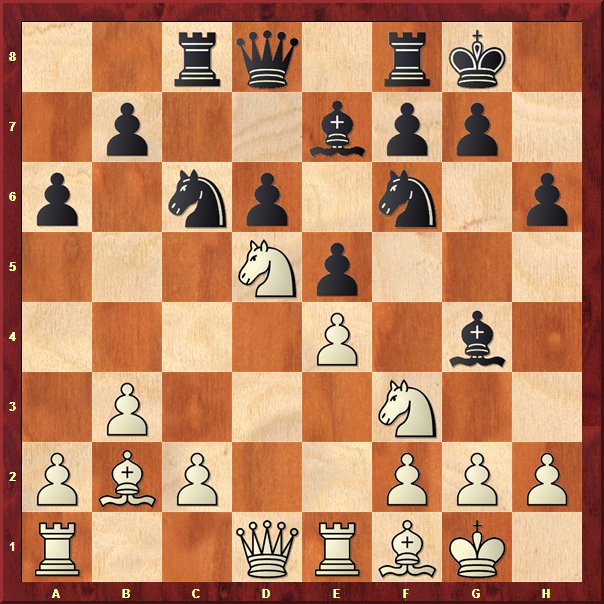
In this position, I chose 21.Be4, however, 21.d6! is much stronger. What we both overlooked is that after 21…Bxf3 22.dxe7 Qxe7 23.Re3 Bb7 24.Nd5! with the double threat of Nxe7 and Rxa3. Nevertheless, it is still very difficult to win after 24…Bxd5 25.Rxa3 Bc6 26.f3 b5. The rest of the game gave neither of many chances to create play. As such, a draw was a justified result. Or as Nigel would put it, “chess is a draw and the rules need to be changed.”
Overall, I cannot complain with the results other than the scoring system as I would have preferred a win and a loss since it would give me one more point! Right now, three draws is not what I would have wanted, but it is better than losing three games! For now, I am going to spend the rest day exploring Soho and getting ready for the game against Magnus tomorrow. Have a great day everybody!
Cheers,
Hikaru
London, 11.12.09
November 30, 2009 • General
Hello out there to everyone once again. Before I talk about the recent tournament in Norway, I would like to take a moment to explain why I have not been blogging much of lately. Recently, I have become extremely busy boht in terms of chess and other events in Seattle. As such, I feel that the quality of my recent blogs has been lacking due to the limited amount of time which I have had to communicate my thoughts. My personal feeling is that any blog or book for that matter should be quality over quantity. For the first time in over a month, I have a chance to settle down and not feel rushed.
Towards the end of the disaster in Amsterdam, I received word about the possibility of participating in the BN Bank Blitz this November in Norway. After a brief communication, I agreed to play as I felt it would be a good opportunity to warm up before London and get another crack at Magnus Carlsen. The tournament had an interesting format with sixteen players; ten invited and six qualifiers from local tournaments around Norway. These 16 players were then broken down into four groups of four with the top two players of each group advancing to the quarterfinals at which point it became a knockout.
Preliminary Qualifier:
In the qualifier, I was in a group with GM Leif Erlend Johannessen and local qualifiers FM Kjetil Stokke and the young Anders Hobber. The basic goal in the preliminary stage was to avoid any calamities against the two weaker plays and just not lose to Johannessen. I did not have any major problems as I won the four games against the qualifiers. Leif on the other hand presented a few problems. The first time I ever played Leif was way back in Bermuda in 2002 (wow, that feels like another lifetime ago)when I made my second grandmaster norm. More recently, I beat him in the 2006 Turin Olympiad when we beat Norway 3.5-.5 to capture the bronze medal. Although Leif stopped playing chess seriously in order to finish a law degree, he has always been a dangerous opponent. In the first game against him, I got a bit lucky as he had a strong kingside attack. However, after a minor error I was able to capitalize for the full point. In the second game, I obtained a very small advantage and he self destructed as his time got a bit too low. This left me with 6/6 out of the first stage and looking forward to the next stage.
Quarterfinals:
In the quarterfinals I faced GM Kjetil Lie also from Norway. Prior to playing in the Gjovik rapids last year I had never faced Kjetil. During that tournament I became aware of his style as we played four times. Despite my 3.5-.5 score, he can be a tricky player. This time around was not much different as he had problems finding a way of reaching equality against the Trompowsky in both of his Black games. I won my black game without any problems either which helped me advance 3-0.
Semifinal: The semifinal was when the real tournament began for me as I had to play GM Peter Heine Nielsen from Denmark. Although Nielsen has yet to break 2700, he has always been a super solid GM who does not lose very often. Luckily for me this was blitz and not classical so I knew I would have some opportunities. In the first game, I got Black and played the Queens Gambit Accepted. We reached a rather tame position as queens came off the board early. After reaching a pretty equal position, I was able to slowly outplay him as we started drifting lower and lower on time. After winning the first game with Black, I knew my chances had drastically improved. In the second game, things did not improve for Peter as we repeated a similar variation from our game in Amsterdam. After going for a different idea, I was able to pick up two pawns and had a much better position. Unfortunately, it was here when he was down to seconds that I let the game slip and was probably only equal at the point when he accidentally overstepped on the clock. In the third game, with such a big advantage, Peter really had to go for broke. Despite trying the aggressive 3.e4 system against the Queens Gambit Accepted, he ran into trouble early on when he got a bit too ambitious while trying to win in the opening before reaching the middlegame. This led to catastrophe as he got his queen trapped on a7. This led to an early resignation and a 3-0 victory for me once again. Not more than 30 seconds later, Magnus won his third game against Jon Ludvig to advance by a score of 2.5-.5 which setup the dream final for the organizers.
Final:
In the final I faced off against Magnus Carlsen. Little needs to be said about him as he has proven to be one of the best in the world and recently won the World Blitz Championship. Before I delve into this match I would, for the last time, like to emphatically state that I never received an invitation to play in the World Blitz Championship despite rumours that I turned down such a request. Obviously I would have played in that event had I gotten an inviation. Onto the match, I knew that I was undefeated at 12-0, but was concerned about how my nerves would hold up at the start of the match after cruising through the prelims and matches. The first game proved my worst fears as I chose a rather dubious variation of the English. When combined with the fact that I more or less fell asleep at the board (not literally) and used a minute and a half to get out of the opening with barely equality, it doomed my chances. I almost immediately went wrong and lost without obtaining any realistic drawing opportunities. After such a bad start, I thought I would turn on the secondary gear and wake up. Much to my horror this did not prove to be the case as I blundered horrendously in the second game when I allowed 24.Nf5. Shockingly, I had seen Nf5 but forgot that after intentionally hanging the pawn on d6, Ba4 was not possible as my rook on e8 was en prise. This very unwelcome surprise wrecked my position and I almost certainly should have lost from here. However, caissa seemed to have different plans as I was able to complicate it a bit thereafter. Nevertheless, Magnus kept his wits and still had a completely winning position. Luckily, I was able to hang on long enough that we both were down to mere seconds. It was at this point that Magnus went astray when he traded into a knights endgame. At this point I was still lost, but I found a way to trick Magnus into a losing king and pawn endgame. After he miscalculated the pawn race, I queened first with check and went on to win the game. This balanced the score at 1-1. Realizing how lucky I had been to not lose, let alone win, I took a deep breath and slowed everything down in the third game. This turned out to be a very wise decision as we played a pretty straight forward Grunfeld in which I sacked a pawn on c3 to gain initiative. Having looked at this variation in depth with GMs Shulman and Onischuk during the olympiad I felt pretty confident and came out with a lot of play. Despite being down a pawn, my position was slightly easier to play and I eventually was able to pick off a few pawns and convert the advantage into a win. This put me up 2-1 heading into the fourth and final game with Black. Needing only a draw, I once again decided to go into the nimzo, but I chose to play like Michael Adams when I chose the 5…ne4 variation. This turned out to be a very wise choice as I was never really in much danger throughout the game. Many people have suggested that this game should have ended in a draw, but had this been an earlier game in the match, I most certainly would have avoided a repitition myself! Alas, Magnus was in the unfortunate position of having to avoid the repitition and I won the game after picking off all his pawns in a rook and bishop vs queen ending. Thus, I won the match 3-1.
Overall, I felt that my play was pretty good; unfortunately, the finals were a bit of a letdown for me personally. Having played so well and calmly throughout every game up until that point, it is hard to improve. Putting that aside, I felt that I was a bit too nervous and was not ready to up my play to the next level. Luckily, I calmed down and soundly outplayed Magnus in games 3 and 4. Objectively, I think the score should have been 2-2 but I am still happy that I won. For me, this was a nice victory, but I am looking forward to London a lot more and hope to put together a strong tournament there. Last but not least, I would like to thank the organization of the tournament and the sponsor BN Bank for putting together a great tournament as well as Dag Danielsen and Oystein Brekke for their involvement as well.
That is all for now, time to get ready for the event in London. Have a great week everyone!
November 02, 2009 • General
Hello everybody! Unfortunately, I have been extremely busy with life (not chess related). This past weekend was also extremely busy as I was up in beautiful Vancouver at a book launch party for Bullet Chess: One Minute To Mate. This will be the subject of a blog shortly, but for now I will give everyone a simple recap of the US Chess League weeks 8 and 9.
In week 8 we were paired against the Tennessee Tempo. Unfortunately for the Tempo, they chose to run their two GM lineup when I was not around, so they were huge favourites. However, in typical Tennessee style, (look at them Titans) they also managed to lose when they ran that lineup as FM Mikhailuk came up huge as he crushed GM Shabalov in a classical Sicilian. This time around, the Tempo went with a much softer lineup as they featured Ron Burnett on board 1 and Todd Andrews on board 2 followed by Peter Bereolos and John Bick closing it out. In my game, there is not much to say other than the fact that Burnett clearly was not prepared for the game and went astray nearly immediately as I was already equal or better by move 15. The rest was simply technique and I had no serious issues in converting. On board 2, Serper played a Botvinnik English and cruised to victory as well. On board 3, Readey played a solid and extremely slow old Indian type of setup and slowly built up an advantage. With looming time pressure, Readey had several chances to win, but he missed tactical shots at crucial times. In fact, even at the end of the game he was still winning when he chose to repeat the position, alas, we still clinched the match even with this debacle. On board 4, NM Howard Chen came out swinging in a Caro Kann and had a clean K.O. of John Bick. Bick has been playing a bunch of offbeat or flat out losing openings, (Young-Bick) so I think it was caissa’s way of punishing him for such stupidity. Overall, we won the match 3.5-.5 without the outcome ever being in doubt.
Week 9 featured us going up against the red hot Arizona Sluggers. I faced off with Alejandro Ramirez on board 1 and was slowly grinding him until I completely overlooked Nd2 which equalized and maybe more. Sometimes you make mistakes, and I just did that’s all there is to it. On board 2, Slava played Levon “I want to draw every game” Altounian. The game featured standard anti-Grunfeld theory until Slava came up with a new (and very bad) idea involving g5. Levon correctly met it with h4 and the g pawn eventually became horribly weak and Slava lost a simple endgame without much of a fight. On board 3, Marcel came out swinging in the benko against Robby “I used to be good at bullet” Adamson. After getting a significant advantage, Marcel made a serious inaccuracy with f4 and the game petered out into a draw. On board 4, Josh faced off against Amanda Mateer in the new age Nimzo with 5.e4. The opening looked pretty balanced and seemed to be heading for a draw. Unfortunately, Josh misevaluated the situation and tried to press on for a win despite being down a piece. Nevertheless, he showed great team spirit and I have nothing but praise for his attempts at trying to win. Overall, it was not our best match as I blew good winning chances, Marcel blew a win and Josh never should have lost. Thus, we just have to avoid such situations in week 10 and the playoffs.